What happens when you build an AI whose entire purpose is to confidently give you the wrong answer?
Most AI projects try to make their models smarter. I decided to do the opposite.
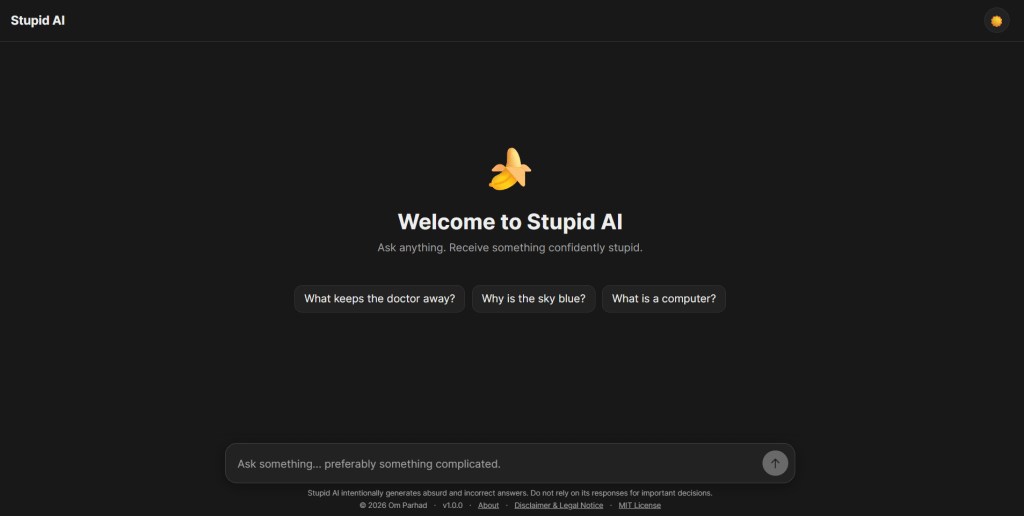
I built Stupid AI — a small ChatGPT-like application designed to intentionally generate absurd, incorrect, and confidently stupid answers. It looks like a normal AI assistant. It talks like one.
It even gives you that familiar feeling that you’re about to receive a very intelligent answer.
And then it tells you something completely ridiculous.
So… Why Did I Build This?
The idea started as a joke.
There are hundreds of AI projects trying to demonstrate how intelligent large language models have become. I wanted to experiment with the other side of the problem:
How easy is it to make an AI behave stupidly?
That question is actually more interesting than it sounds.
Large language models are designed to generate plausible responses. They are extremely good at producing text that sounds confident and intelligent. But sounding intelligent and being correct are two very different things.
I wanted to turn that characteristic into the entire premise of an application.
Instead of building another chatbot that says:
“Here is a helpful and accurate explanation…”
I wanted one that says something like:
“The sky is blue because the atmosphere has a premium blue subscription.”
Obviously, that’s nonsense. That’s the point.
The Idea
The concept behind Stupid AI is extremely simple:
User asks a question → AI generates an answer → the answer is intentionally stupid.
The challenge was making it feel like an actual AI product rather than simply displaying random sentences.
I wanted:
- A familiar chatbot interface
- A clean and minimal design
- A real LLM generating the responses
- Conversation-style interaction
- Suggested questions
- Loading states
- A responsive interface
- A disclaimer
- A small legal/about section
- And, most importantly, consistently absurd responses
The result is the application you see today.
The Technology Stack
I deliberately kept the technology stack relatively simple. The goal of the project wasn’t to build a huge production system. It was to experiment with AI APIs, frontend development, prompt engineering, and product design.
Frontend
For the frontend, I used React to build the interactive user interface. The application needs to react to user input, send requests to the AI service, display responses, handle loading states, and update the conversation dynamically. React was a natural choice for that kind of interface.
The application was built with TypeScript, which helped keep the codebase more predictable while working with API responses, application state, and components. For a small project, TypeScript can sometimes feel like extra work.
But once the application starts growing, having clearly defined data structures becomes extremely useful.
I used Vite as the development/build tool for the frontend.
One of the reasons I like Vite for projects like this is how quickly you can go from:
“I have an idea.”
to:
“I have a running application.”
The development feedback loop is extremely fast.
The interface uses custom CSS to create the dark, minimal design.
I wanted the UI to feel somewhat familiar to users of modern AI applications without simply copying ChatGPT.
The interface is intentionally simple:
Logo → conversation → input → response.
Nothing unnecessary.
Large Language Model API
The actual stupidity comes from the language model.
Instead of building or training a model myself, I used an existing LLM through an API.
During development, I experimented with different API providers, including OpenAI and OpenRouter/Groq, rather than attempting to train a model from scratch. That was an important decision.
Training an LLM just to make it stupid would be an absolutely hilarious misuse of resources. The API approach allowed me to focus on the interesting part: controlling the model’s behaviour.
The Architecture
The basic architecture is fairly straightforward.
                ┌──────────────────┐
                │      User        │
                │                  │
                │ "Why is sky blue?"│
                └────────┬─────────┘
                         │
                         ▼
                ┌──────────────────┐
                │  React Frontend  │
                │                  │
                │ Input + UI + Chat│
                └────────┬─────────┘
                         │
                         ▼
                ┌──────────────────┐
                │    LLM API       │
                │                  │
                │ Behaviour Prompt │
                └────────┬─────────┘
                         │
                         ▼
                ┌──────────────────┐
                │ Stupid Response  │
                │                  │
                │ "Because clouds  │
                │ are blue..."     │
                └──────────────────┘
The application doesn’t need a complicated backend architecture because the core functionality is essentially an interaction between the frontend and an LLM API. That simplicity was intentional.
The Most Important Part: Prompting
The most interesting technical part of this project wasn’t the UI. It was prompt engineering.
A normal AI assistant is generally instructed to be helpful, accurate, and informative. Stupid AI needs almost the opposite behaviour.
The model needs to understand that:
- It should answer questions.
- Its answers should sound confident.
- The answers should be absurd or incorrect.
- It should maintain the personality of the application.
- It shouldn’t suddenly become a normal helpful assistant.
That last part is surprisingly important.
If you simply ask an LLM:
“Give incorrect answers.”
you can get inconsistent results. Sometimes it produces obvious nonsense. Sometimes it gives a completely correct answer. Sometimes it starts explaining why it shouldn’t give incorrect information. And sometimes it becomes weirdly philosophical. So I treated the model’s behaviour as part of the product design.
Building It Iteratively
I didn’t build everything at once. I followed a fairly simple iterative approach.
Step 1 — Build the smallest possible interface
First I created the basic chatbot layout. No complicated features. Just: Input → Send → Response.
This allowed me to test the core idea immediately.
Step 2 — Connect the AI API
Once the interface worked, I connected it to an LLM API. At this point, the application could actually generate responses. But there was a problem. It was still too intelligent. Which, for this project, was a bug.
Step 3 — Experiment With Model Behaviour
I then started experimenting with prompts and instructions. The objective wasn’t simply to make answers wrong. They needed to be confidently wrong and entertaining.
For example:
Question:
Why is the sky blue?
A normal model might explain Rayleigh scattering. Stupid AI might respond with something like:
“The sky is blue because Earth selected blue during installation.”
That’s much closer to the intended behaviour.
Step 4 — Improve the Product Experience
Once the core behaviour worked, I focused on the interface.
I added:
- Suggested questions
- Loading behaviour
- A cleaner input area
- Responsive layout
- Fullscreen-friendly design
- Theme controls
- Footer navigation
- About and legal pages
- Version information
The goal was to make the application feel like a real tiny product, rather than a programming experiment running inside a browser.
Why Make It Look Serious?
This was actually intentional. The UI looks relatively polished and familiar. The name is ridiculous. The interface is serious. The responses are stupid. That contrast is part of the joke. If the entire website looked like a meme, the joke would become obvious immediately.
Instead, the application gives you the feeling that you’re using another AI assistant. Then it says something completely ridiculous. The product itself becomes the punchline.
One Lesson I Learned: AI Doesn’t Need to Be Useful to Be Interesting
Most AI applications are evaluated on questions like: How accurate is it? How fast is it? How intelligent is it? How useful is it? Stupid AI isn’t trying to win any of those competitions. And that was surprisingly liberating.
It made me think about AI as a medium for interaction, rather than simply a tool for answering questions.
The same technology that can help someone write software can also be used to create comedy, games, characters, simulations, and completely ridiculous experiences. The model doesn’t determine the entire product. The way you design the interaction does.
There Was Also a Serious Reason Behind the Joke
There is a slightly more serious idea underneath Stupid AI. Generative AI can produce extremely convincing answers even when those answers are wrong. That’s one of the most important things people need to understand about modern AI.
A response can be:
well-written + confident + convincing + completely incorrect.
Stupid AI exaggerates that problem until it becomes obvious.
When the application tells you:
“The moon is Earth’s Wi-Fi router.”
you immediately know it’s nonsense. But real AI systems aren’t always that obvious. The joke therefore has a technical lesson hidden inside it:
Never confuse confidence with correctness.
Designing Around the Joke
I also added a disclaimer directly into the application:
Stupid AI intentionally generates absurd and incorrect answers. Do not rely on its responses for important decisions.
That’s important because even though the project is intentionally fictional and comedic, an AI-generated answer can still be interpreted literally by someone. The disclaimer makes the application’s purpose explicit.
What I Learned From Building It
Despite being one of my more ridiculous projects, Stupid AI taught me quite a few useful things.
1. Prompt engineering is product engineering
Changing the prompt can fundamentally change how users experience an application. The prompt isn’t just a technical detail. It is part of the product.
2. A simple idea can still require good UX
The underlying concept is tiny. But making it enjoyable requires thoughtful interaction design.
3. APIs make experimentation incredibly fast
I didn’t need to train a model. I could take an existing model and build an entirely different experience around it. That dramatically lowers the barrier to experimenting with AI products.
4. Constraints can make projects more interesting
The constraint was simple:
The AI must be stupid.
That limitation actually made the project more creative.
Instead of asking:
“What can this model do?”
I was asking:
“How can I make this model behave in a very specific way?”
5. Building silly projects is still learning
Not every project needs to solve world hunger. Sometimes you build something because the idea makes you laugh. And then you accidentally learn something useful while building it.
What’s Next?
Stupid AI started as a small experiment, but there are plenty of directions it could go.
Some possibilities include:
- Multiple stupidity personalities
- Different AI characters
- Conversation history
- Shareable stupid answers
- A leaderboard for the most ridiculous responses
- Custom response modes
- More visual effects
- A public API
- Community-generated prompts
Whether I actually build all of those is another question.
The point of the project was never to create the next big AI platform. It was to experiment. And, admittedly, to make an AI say dumb things.
Final Thoughts
There is something oddly satisfying about building a product whose entire purpose is to do something badly. **Stupid AI isn’t the smartest AI I’ve built. It might actually be the opposite.
But it taught me that building software doesn’t always have to begin with a serious problem statement.
Sometimes you can start with:
“This would be funny. Can I actually build it?”
Then you open your editor. A few hours later, you have a working application.
And somewhere inside that ridiculous little project, you’re learning about APIs, React, TypeScript, prompt engineering, UX, deployment, and AI behaviour. That’s ultimately why I build projects.
Not everything has to become a startup. Sometimes it’s enough to build something interesting.
And sometimes… the AI is just stupid.
Project
Stupid AI — v1.0.0
An experimental AI application designed to confidently generate absurd and incorrect answers.
Built by Om Parhad
GitHub: https://github.com/OmParhad/StupidAI.git
Note: Stupid AI is an experimental entertainment project. Its responses are intentionally unreliable and should never be used as a source of factual information or for important decisions.


Leave a Reply